
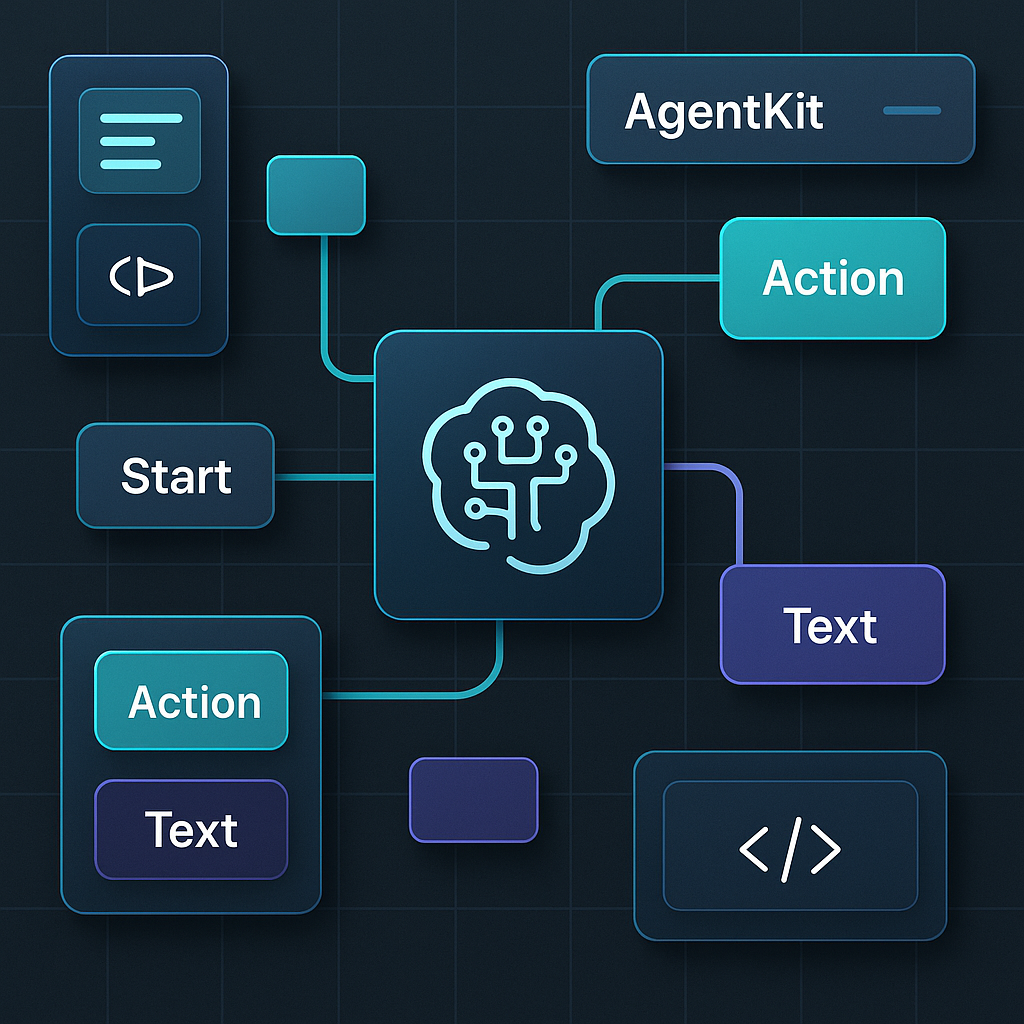
OpenAI has officially launched AgentKit at its DevDay 2025 conference in San Francisco, introducing a game-changing visual agent builder that transforms how developers create AI agents. This announcement marks a significant shift in OpenAI’s strategy from being purely a model provider to becoming a comprehensive ecosystem platform.
What is AgentKit?
AgentKit is a complete set of tools designed to help developers and enterprises build, deploy, and optimize AI agents efficiently. Until now, building agents required juggling multiple fragmented tools with complex orchestration, custom connectors, manual evaluation pipelines, and weeks of frontend development work. AgentKit solves these challenges by consolidating everything into one unified platform.
Key Components of AgentKit
1. Agent Builder
The centerpiece of AgentKit is the Agent Builder, which CEO Sam Altman described as “like Canva for building agents.” This visual canvas allows developers to:
– Design agent workflows using drag-and-drop nodes
– Connect tools and configure custom guardrails
– Access preview runs and inline evaluation configuration
– Implement full versioning for rapid iteration
– Start with prebuilt templates or create from scratch
During the live demonstration, OpenAI engineer Christina Huang built a complete AI workflow and two agents in under eight minutes, showcasing the platform’s efficiency.
2. ChatKit
ChatKit provides a simple embeddable chat interface that developers can integrate into their own applications. This toolkit enables businesses to bring chat-based agent experiences into their products while maintaining their own brand identity and unique workflows.
3. Connector Registry
The Connector Registry serves as a central hub for admins to manage how data and tools connect across OpenAI products. It includes:
– Pre-built connectors to Dropbox, Google Drive, SharePoint, and Microsoft Teams
– Support for third-party MCP (Model Context Protocol) servers
– Secure management of data across workspaces
– Admin control panel for maintaining security and control
4. Enhanced Evaluation Capabilities
AgentKit introduces powerful evaluation tools including:
– Step-by-step trace grading
– Datasets for assessing individual agent components
– Automated prompt optimization
– Third-party model support for performance measurement
Real-World Impact
Companies are already seeing dramatic results with AgentKit. Fintech company Ramp reported that Agent Builder transformed their development process:
“Agent Builder transformed what once took months of complex orchestration, custom code, and manual optimizations into just a couple of hours. The visual canvas keeps product, legal, and engineering on the same page, slashing iteration cycles by 70% and getting an agent live in two sprints rather than two quarters.”
Similarly, LY Corporation, a leading Japanese technology company, built a work assistant agent in less than two hours using Agent Builder.
Availability and Pricing
As of October 6, 2025:
– ChatKit and new evaluation capabilities are generally available to all developers
– Agent Builder is available in beta
– Connector Registry is beginning its beta rollout to some API, ChatGPT Enterprise, and Edu customers with a Global Admin Console
– All AgentKit tools are included with standard API model pricing
– OpenAI plans to add a standalone Workflows API and agent deployment options to ChatGPT soon
Competitive Landscape
With this launch, OpenAI is positioning itself to compete directly with workflow automation platforms like Zapier, n8n, and Make. The integration of visual workflow building, chat interfaces, and comprehensive evaluation tools in one platform represents OpenAI’s evolution into a full-stack application provider.
The announcement comes as ChatGPT has reached 800 million weekly active users, demonstrating the massive scale at which OpenAI operates and the potential reach for developers building on the platform.
Conclusion
AgentKit represents a significant milestone in making AI agent development accessible to a broader range of developers and enterprises. By dramatically reducing the technical barriers and time investment required to build production-ready agents, OpenAI is accelerating the adoption of agentic AI across industries. As Sam Altman noted during the keynote, “This is all the stuff that we wished we had when we were trying to build our first agents.”
The platform is now available for developers to explore, and with its comprehensive toolkit and user-friendly interface, AgentKit is poised to become a central platform for the next generation of AI-powered applications.
Leave a Reply